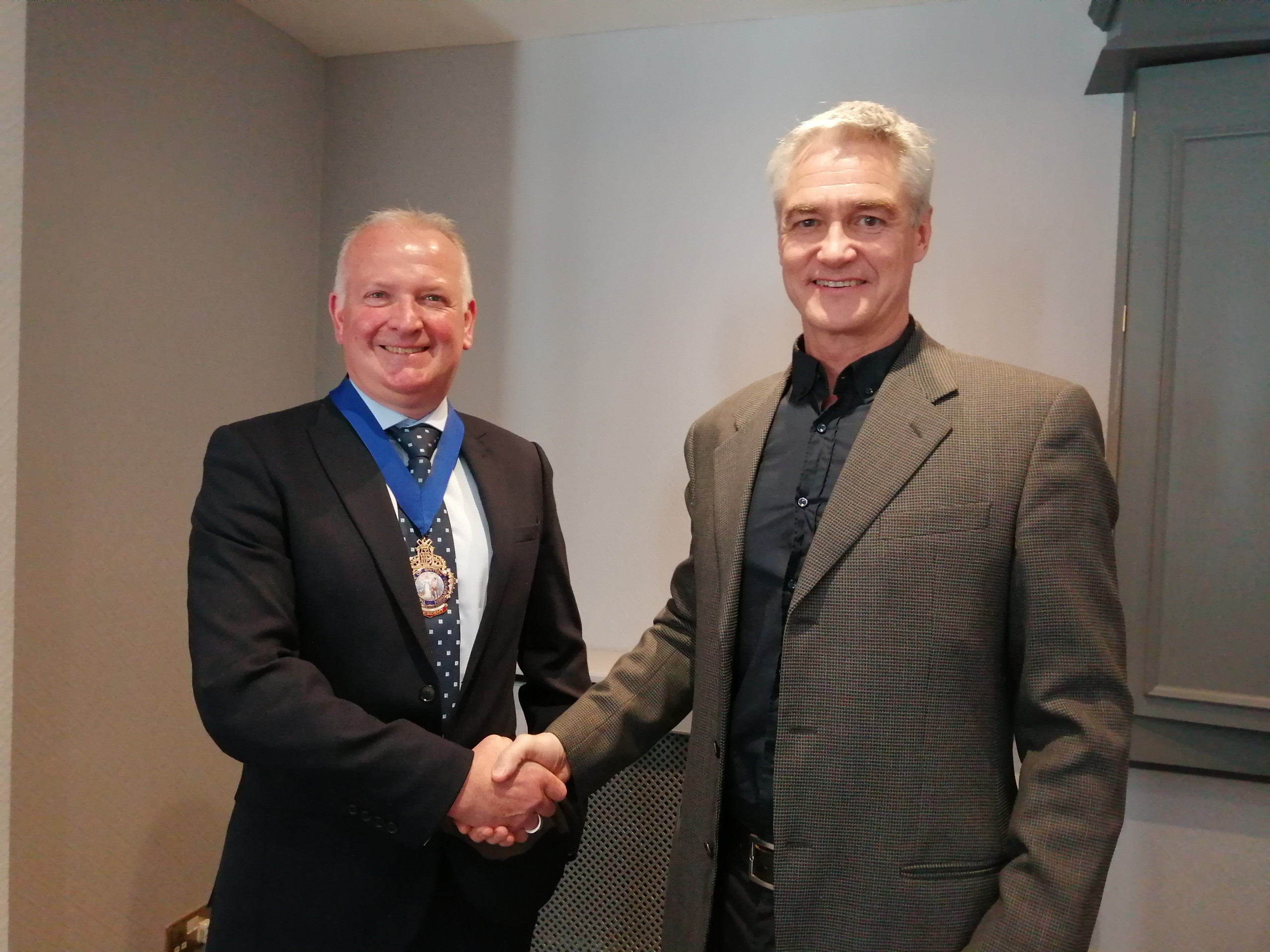
A Look to the Future for our Industry from our new ICME National President, Anthony Evans CEng FICME.
Here is the Address from our new ICME National President, Anthony Evans CEng, FICME.
I feel very privileged, and honoured, to have been elected as President of the Institute of Cast Metals Engineers. I joined the ICME in 2001 as a graduate engineer and thank the Institute greatly for all the support I received in my professional development to becoming registered as a Chartered Engineer and also to Fellow Grade.
The ICME’s vision is to deliver as the renowned professional organisation for cast metals engineers and I greatly look forward to working with my fellow Officers, Trustees, the staff at head office and our Members to ensure the Institute delivers this vision.
As a foundation industry we are recognised globally as a sector that makes effective use of secondary materials. But I don’t think the industry yet receives enough recognition as an industry capable of full lifecycle reclamation and as one, therefore, that is pioneering circular economy principles through metallurgical science. This is something we can collectively work on.
In very recent times, the non-ferrous sector has seen its greatest transformation for many decades, through the advent of Giga, and subsequently Mega, die casting cells for the automotive sector. These castings may not deliver the high integrity standards that purists with our industry (including myself) are used to delivering, yet we must accept and acknowledge the benefits OEM’s can experience with this new manufacturing concept.
It is very positive to see the ferrous sector also adopting this multi part integration strategy to lead in sustainability and efficiency. Simplifying assembly processes to dramatically reduce carbon emissions and therefore fully supporting sustainable automotive manufacturing is something we can all welcome.
As one of the primary industries, we potentially also hold the key as the lead for digitalization of manufacturing and in the adoption of advanced mathematical modelling. Utilizing digital twin virtual models and exporting data meshes to customers’ FE software enables full simulations with data mapped material properties, enabling enhanced product test analysis and therefore reduced costly prototype builds. The program time and cost savings available here are significant.
We also have a huge opportunity to align with material processing organisations, institutions and academics, to enhance the use of secondary materials for all of our processes, as opposed to further primary plant decarbonisation capital costs. Through this we can strive to eliminate the current market perception as two separate industries for premium material supplies.
Innovative supply chains are also critical for our industry’s success. It is fair to admit that we didn’t fully capitalize when low cost economies temporarily became unappealing to OEM’s. Many examples of Asian foundries currently relocating their plants to countries closer to the West demonstrates that supply chain initiatives are a global challenge – and therefore an opportunity for our business here in the UK.
Carbon reduction challenges, through new processes, digitalization, technologies, material and supply chain innovation, provide extensive strategic opportunities for the ICME to support our professional membership with technical resources and focussed networking opportunities.
The United Kingdom is home to some of the world’s leading academic institutions, who are pushing the boundaries of fundamental research and full circulation models for metals and other materials. As an institute we already encourage members to consider advanced academic collaboration within industry and this is something we can continue to champion and enable.
Our industry will not be able to sustain these opportunities in the future without the development of young people. ICME’s future skills project is a significant enabler to deliver this industry need and to provide engagement programmes which support CPD for all of our members, as well as encouraging new talent to join the industry.
By linking the ICME training and the Diploma in Casting with advanced academic institutions we can look to provide an exceptional, and unique, career pathway from schools through to PhD research in industry critical fields.
Our industry has a very positive global image of professionalism and this can be further developed through offering global membership. Exploring membership opportunities within North America and Asia could enable significant membership growth with relatively low investment costs.
Striving towards an enhanced global coverage will require the institute to consider, and invest in, greater digitalization of our operations as well as more use of social media and developments in digital communication channels.
To summarize, our industry is continuing to innovate and develop with new opportunities in new markets. We need to call on our membership to share these experiences and ensure the Institute also innovates and develops in line with industry and can embrace these global opportunities.
I truly believe that working in partnerships, and with teamwork, is critical to any organisation’s growth and success.
I would like to thank Martin Dudley for all the good work he achieved in his year of office and I greatly look forward building on this and to continuing the recent ICME developments in support of our members in the year ahead.
